What is a Distributed Antenna System? A Comprehensive Guide for Enhanced Connectivity
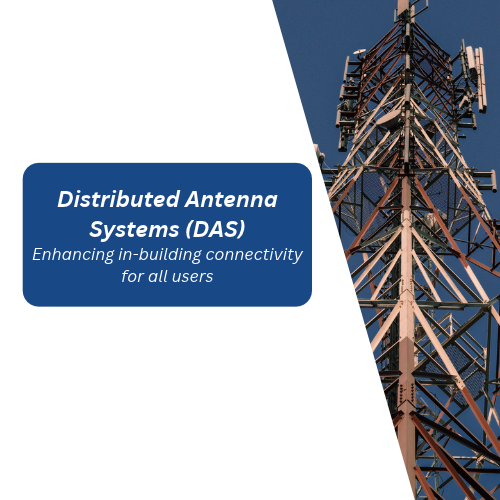 A Distributed Antenna System (DAS) is a network of strategically separated antenna nodes connected to a common source that boosts wireless/cellular coverage. This common source is usually a main tower or base station antenna that receives the wireless signals.
These signals are processed and amplified at a central equipment hub, preparing them for distribution. Enhanced signals are then sent through fiber optic or coaxial cable to the remote antenna nodes placed around a venue. Once received, the remote antenna nodes broadcast these enhanced signals to mobile devices, helping to improve overall connectivity.
Types of DAS architecture
DAS networks can be configured using different architectures and signal sources. The types of DAS architecture include:
•
Passive DAS: Uses passive RF components like coaxial cables, splitters, and couplers to distribute signals. This architecture is the most cost-effective, making it ideal for smaller buildings with lower capacity needs (schools, hotels).
•
Active DAS: Converts RF signals into digital signals and distributes them via fiber optic or Ethernet cable to remote access units, which then converts it back to RF. Despite this architecture being higher in cost, it results in virtually no signal loss, making it ideal for huge venues like stadiums.
•
Hybrid DAS: A combination of the two – uses both fiber optic and passive coaxial cables. This is often used in large area to balance cost and performance.
•
Digital DAS: Digitalises RF signals at the source and transports it as packets over cabling (Ethernet/fiber) directly to smart endpoints.
Where is a DAS used?
A Distributed Antenna System is used in a number of environments, differing in size, complexity, and density. It is generally considered an in-building solution, helping to enhance connectivity and penetrate thick structural layers of concrete or metal. These materials create severe signal attenuation, resulting in deep shadow loss. DAS solutions ensure seamless coverage in environments where material density overwhelms traditional networks, such as...
•
High-rise buildings, building cores, basements, high-speed elevators etc: These structures are what contain reinforced concrete and energy-efficient coated windows, which are both notorious for blacking RF signals.
•
High capacity venues e.g., stadiums & airports: The added challenge in these venues is sheer capacity, with tens of thousands of users needing coverage. DAS solutions provide the backbone to support immense user data and vital venue operations, including smart cameras and facial recognition.
•
Tunnels & Subways: The constrained geometry in long, narrow environments limits wave propagation. To overcome this, DAS solutions use specialised Leaky Feeder cables to help leverage time diversity.
What makes a good DAS?
There are several RF components that go into developing a DAS. For example, a high-quality
base antenna is required to receive the wireless signals that are eventually received by the remote units. However, this is of no use if you aren’t equipped with several high-quality
remote antennas that distribute the signal around the venue/building. In addition, this transfer of signal is only made possible through high-quality
fiber optic or coaxial cables, depending on your chosen DAS architecture. During this transfer, the signal needs to be divided and routed to the correct remote antenna, meaning
splitters and tappers must also be of a high calibre.
Building a DAS with antennaPRO
DAS solutions require high-quality RF components as they are designed to overcome the most complex environmental constraints. At antennaPRO, we offer Amphenol Procom’s wide range of connectivity products, who have
70+ years of trusted engineering excellence. If you are interested in developing a Distributed Antenna System, get in contact today at 01227 743099 or email us at sales@antennapro.co.uk.
01/10/2026
