VSWR Explained: Why it matters to your antenna system
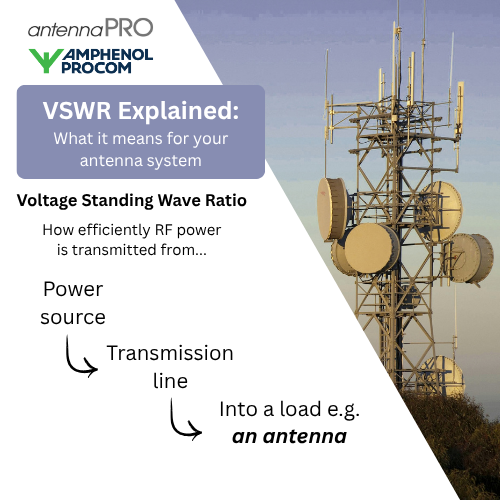 Voltage Standing Wave Ratio (VSWR) is a measurement of how effectively radio-frequency power is transferred between a transmitter and an antenna. It is the ratio of maximum to minimum voltage on a transmission line, with a good ratio helping to maximise an antenna’s performance and reduces the percentage of causing an impedance mismatch and power reflecting back to the source.
What causes a high VSWR?
Voltage Standing Wave Ratio (VSWR) is a measurement of how effectively radio-frequency power is transferred between a transmitter and an antenna. It is the ratio of maximum to minimum voltage on a transmission line, with a good ratio helping to maximise an antenna’s performance and reduces the percentage of causing an impedance mismatch and power reflecting back to the source.
What causes a high VSWR?
There are several factors that causes a high VSWR and an impedance mismatch. Faults in the antenna are a common cause, such as the antenna being damaged or completely broken at the feed point. This may cause the antenna be become disconnected and not operate as a result. Also, the antenna not being tuned to the correct operating frequency can greatly reduce transfer efficiency.
Improper connections also cause a high VSWR, such as RF connectors being loose, improperly torqued, poorly soldered, or worn out. Insufficient connection is also caused by coaxial cable and feeder damage. These can be damaged in a number of ways so must be closely monitored, such as being crushed, sharply bent, kinked, or internally broken. In addition, the use of poor quality connectors or incorrect cables as a whole will create issues in the first place.
Water ingress like unwanted moisture and water leaks will also negatively impact VSWR readings, as well as long-term corrosion inside connectors, jumpers, or feeder lines impacting the electrical components. The antenna should also not be mounted too close to obstructions like nature, metal surfaces or conflicting nearby antennas.
What is a good VSWR?
| VSWR |
General Interpretation |
| 1:1 |
Perfect theoretical match |
| 1.2:1 |
Excellent / near perfect |
| 1.5:1 |
Generally very good |
| 2:1 |
Often acceptable, but depends on the system |
| 3:1+ |
Significant mismatch that should be investigated |
This table provides a general guide as to what is considered a good VSWR.
Why does VSWR matter?
A low VSWR means almost all the signal energy reaches the antenna and is radiated out, which is critical to an antenna’s performance. Maximising the amount of signal that reaches the antenna will therefore help increase its coverage area and overall effectiveness. A higher VSWR means waves deflect, creating standing interference patterns that can distort communication signals. These signals are critical in things like radar, satellite links and cellular networks, meaning they cannot be interfered with.
Any reflected power travels back towards the transmitter or amplifier, with this extra voltage or heat potentially damaging internal components in high-power legacy systems. VSWR helps to prevent any damage like this, with regular tracking of changes in VSWR acting as a diagnostic tool. A sudden jump can reveal faults like physical damage, water in the cables, loose connectors, or a broken antenna.
VSWR & antenna selection
When selecting an antenna for an RF system, VSWR is an important specification to consider, however it must be assessed alongside other important specs and the requirements of the application. An antenna with a low VSWR is not necessarily the suitable choice for every application as it must be suitable for the other specifications that every antenna has, such as:
•
Frequency range: Does the antenna require the required frequencies?
•
Gain: Does the antenna provide the required signal coverage?
•
Power handling: Can the antenna safely handle the transmitter output?
•
Impedance: Is the antenna compatible with the rest of the system?
•
Environment: Is the antenna designed for the installation location?
Need help selecting an antenna? antennaPRO supplies a wide range of antennas for applications including TETRA, public safety, military, marine and many more. If you're unsure which antenna solution is suitable for your application, our expert team can provide guidance in this decision.
Contact us now at sales@antennapro.co.uk or call us at 01227 743099.
24/09/2026
