Inside a Coaxial Cable: How Each Layer Keeps You Connected
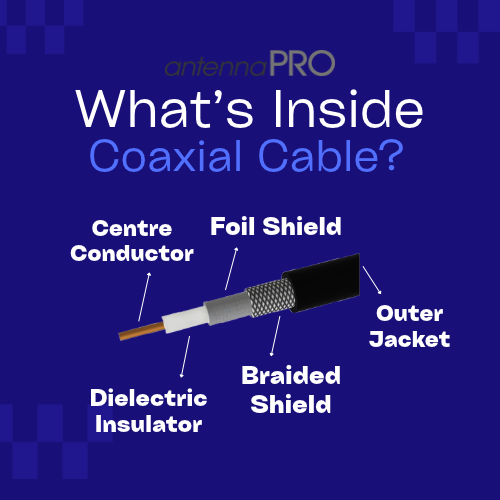 Ever wondered what's inside a coaxial cable and how each layer ensures reliable transportation of RF signals? Despite their size and diameter, coaxial cable consists of five interconnected layers. Each layer serves it's own unique purpose and allows for reliable connectivity. Cabling is more complex than most anticipate, with each layer providing protection or support for one another.
So, what's the purpose of each layer in a coaxial cable?
1. Centre Conductor
This component is the core of any coaxial cable and is a solid wire (usually copper or copper-clad steel) that carries the primary RF signals through a communication system to the antenna. It serves as the primary pathway for these RF signals, with the other layers acting as protection. In theory, it performs the most important role, however each surrounding layer is what allows the centre conductor to effectively execute this role effectively. These outer layers must protect the centre cable at all costs, with severe damage to the centre preventing the entire cable from transferring any RF signal.
2. Dielectric Insulator
This is what surrounds the central wire. It's typically a plastic layer that separates the centre conductor from the outer shield, helping to maintain consistent electrical spacing. This is a crucial role that helps to prevent short circuits and minimises signal loss. The insulator also ensures the electrical characteristics remain consistent down the entire line. Both of these factors ensure the cable performs consistently and efficiently throughout the whole cable and the wider system.
3. Foil Shield
Whilst the dielectric insulator helps to protect the centre conductor, the insulator is made of a relatively weak material so must be protected itself. The foil shield is a thin sheet of aluminum/copper foil that is wrapped tightly around and covers 100% of the dielectric insulator. It is most effective in blocking high-frequency electromagnetic interference from leaking in or out of the cable, such as Wi-Fi, cellular or radio signals. We are now starting to establish a clear pattern - each layer protects the previous layer whilst performing a unique function.
4. Braided Shield
This pattern continues when examining the next layer. The braided shield is a woven mesh of fine aluminum or copper wires wrapped over the foil layer. Whilst protecting the foil layer, it also targets lower-frequency interference and provides structural strength and flexibility. This means the cable is able to safely bend without damaging any layers, allowing for more flexible installation options. These shields work well in combination and each serve their own purpose. For example, the foil shield allows for 100% high-frequency blocking, with the outer braided layer provided physical cable strength, flexibility and low-frequency absorption.
5. Outer Jacket
Wrapping up all internal layers is the outer jacket - a tough external sheath commonly made of plastic, rubber, or PVC. Whilst it surrounds all internal layers and gives the cable a cleaner look, it's primary role is to protect the other components from physical damage, moisture, temperature changes & environmental wear. In environments where one or more of these factors could pose a threat, a high-quality coaxial cable is especially crucial.
So, what does this all tell us? It shows that cabling is more complex than most anticipate, with each layer providing protection or support for one another. As mentioned there's a clear pattern of each layer protecting the previous, whilst also performing its own unique function. Want to learn more about the different types of RF cable we have on offer? Take a look at our RF cable guide by
clicking here.
27/10/2026
